Torque Drift
- 4.4
- Rating
- 10.00M
- Installs
- Free
- Price
 Analysis by App-foxy
I spent time with Torque Drift as a mobile racing game, and my first impression was clear: this is built around the satisfaction of controlling a car through a slide rather than simply reaching the finish line first. The central appeal is learning how to hold a drift, correct the car when it starts to rotate too far, and gradually make each run look and feel more deliberate. That gives it a different personality from a conventional arcade racer.
It is developed by Hooned Games and is free to download, which makes trying it fairly easy. The game is rated for Everyone, and it runs on devices using Android 8.0 or later. Its current version is 2.32.3, while the game originally arrived on September 26, 2018. Those details matter because this is not a brand-new experiment: it has had time to establish its identity, and its audience is visible in the store figures, with an average rating of 4.4 from around 96 thousand ratings and more than 10 million installs.
Learning the rhythm behind every slide
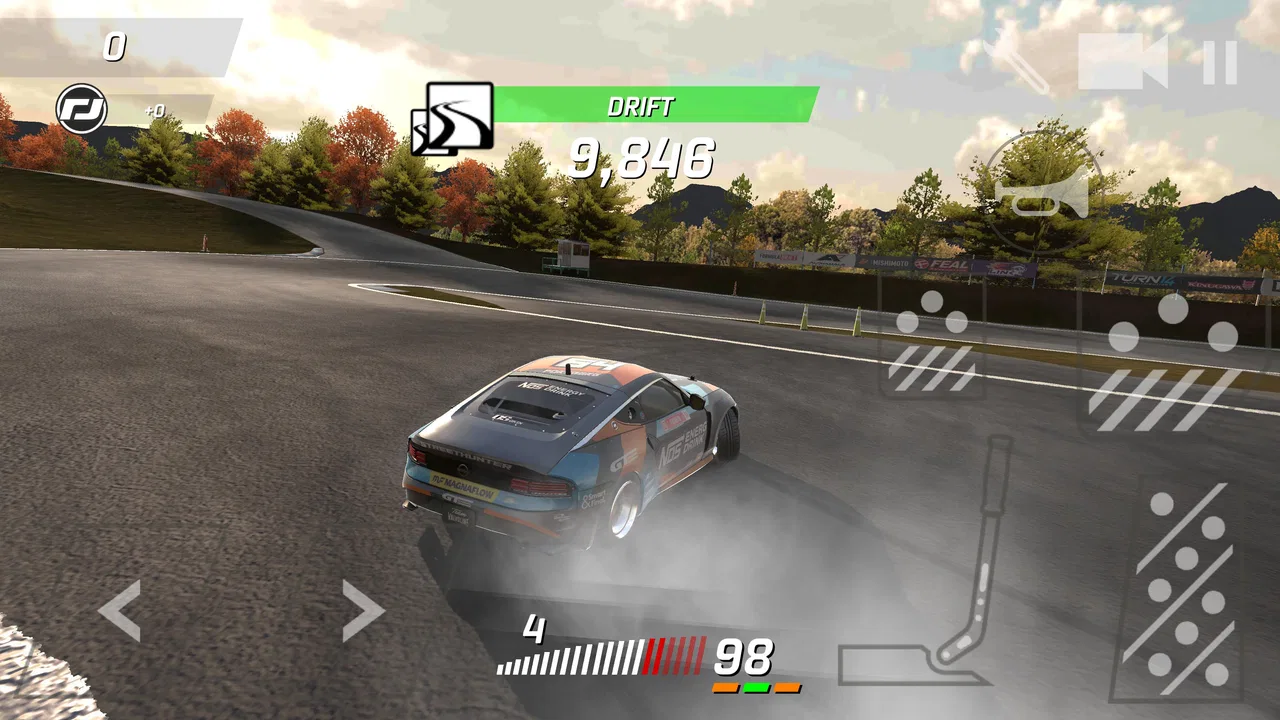
The driving feels most rewarding when I stop treating the car like a normal racing vehicle. In a typical mobile racer, I think about braking points, acceleration, and the cleanest line through a corner. Here, I am thinking about angle, throttle control, and how long I can keep the rear of the car moving without losing the line completely. That change in priorities is what makes the game distinctive.
You May Also Like

 Blood Strike: 2.5 Anniversary
Blood Strike’s Loadouts Turn Every Drop Into a Tactical Gamble
A close look at Blood Strike’s custom loadouts: how fast access to signature weapons reshapes its battle royale rhythm, rewards preparation, and narrows the gap between fights.

 Pandora - Music & Podcasts
Pandora’s Music Is Easy to Start, but Harder to Recover
Pandora’s strength is its low-effort path from a seed to a station. Its weak spot is how much confidence it asks you to place in connection, setup, and quiet recovery.

 8 Ball Pool
 Is Built on Rivalries, Rematches, and Routine
A close look at the rivalries, rematches, shared routines, and unanswered safety questions that turn a quick pool match into a persistent mobile community.

 Samsung Music
’s Quiet Strength Is Playing What You Already Own
Its reach comes less from spectacle than from dependable access to a personal library. That simplicity is both the app’s strongest retention engine and its ceiling.

 AccuWeather: Weather Radar
AccuWeather Review: A Quick, Clear Forecast for Everyday Decisions
For everyday plans, the best forecast is the one you can understand quickly. AccuWeather makes rain timing, radar, and local conditions easy to act on, with a few trade-offs.

 Hill Climb Racing
Why Hill Climb Racing Still Turns Crashes Into One More Run
A tiny car, a bumpy hill and one more upgrade: Hill Climb Racing keeps resurfacing because its simple chaos makes every near-miss feel personal.
More From Our News Desk



At first, drifting can feel less precise than expected. A small steering correction may turn a controlled slide into a spin, while holding the throttle too confidently can push the car beyond recovery. I found that the best approach was to make smaller inputs than instinct suggested. Instead of constantly fighting the car, I learned to anticipate its movement and use gentle corrections. That learning curve is a strength, but it also means the opening sessions may frustrate players who want immediate, effortless speed.
The game’s strongest moments come when several decisions connect. I enter a corner with enough speed, initiate the slide without overdoing it, maintain a useful angle, and then straighten the car before the next section. When that sequence works, the result feels earned rather than automatic. The satisfaction is closer to practicing a skill than simply unlocking the next race.
That makes it especially appealing on short breaks. I can play a few attempts while waiting for a train or during a quiet moment at home, but each attempt still gives me something specific to improve. One session might be about entering corners more smoothly; another might focus on avoiding spins. The game works well when I approach it as practice instead of expecting every run to be perfect.
Why the handling takes patience
Torque Drift is not the best choice if I want a relaxed racer that I can understand in seconds. Its appeal depends on accepting mistakes as part of the process. A failed corner is not merely a lost race; it shows me that my timing, angle, or throttle use needs work. That can be satisfying for a patient player, but tiring for someone who prefers immediate rewards.
I also think the handling makes the game more dependent on personal preference than many racing titles. Some players enjoy a car that feels lively and slightly unpredictable because it gives them room to develop technique. Others prefer direct controls that produce the same result every time. If I fall into the second group, a simpler arcade racer may be a better fit, especially when I want a quick result rather than a driving lesson.
Touch controls require attention to the position of my fingers as well as the car itself. I found it easier to make consistent corrections when I kept my hands relaxed and avoided covering too much of the screen. Playing while walking or in a crowded place is not ideal because the game rewards concentration. A stable grip and a few uninterrupted minutes make a noticeable difference.
What the free entry point really means
The download is free, so I can install the game and decide whether its drift-focused driving suits me without paying first. That is the most important value point here. The game does not require a paid purchase simply to discover whether I enjoy its handling, and the free starting point lowers the risk for curious racing fans.
There are in-app purchases ranging from $0.99 to $74.99 per item. I therefore see the game as free access with optional spending rather than as a completely cost-free experience in every respect. The sensible way to evaluate it is to play first, understand how much I actually enjoy the core driving, and only then consider whether any optional purchase is worthwhile. Paying before I know whether I like the control style would be difficult to justify.
The price range also creates an important trade-off. A small optional purchase and the highest listed item represent very different spending decisions, so I would not describe the game as offering one simple paid value proposition. The free version is the part I can assess directly as an entry point; the value of individual purchases depends on what a player wants and how much time they intend to spend with the game.
For parents, the Everyone rating is useful context, but it does not remove the need to supervise spending on a device that allows purchases. The age classification describes suitability of the content, not whether every optional transaction is appropriate for every household. I would check the device’s purchase controls before handing the game to a child.
Practical ways to get more from each session
My first useful habit was to stop changing several things at once. If I altered my steering, throttle, and entry speed after every mistake, I could not tell what had helped. Instead, I changed one factor per attempt. For example, I would enter the same type of corner slightly slower and watch whether the car became easier to settle. This turns repeated runs into deliberate practice rather than random retries.
A second tip is to value a clean, shorter drift over a dramatic slide that ends badly. It is tempting to chase a large angle because it looks impressive, but control is more useful than spectacle. I improved faster when I focused on exiting the corner in a position that gave me another chance, rather than trying to hold the most extreme angle possible.
I also recommend treating recovery as a skill of its own. When the car begins to rotate too far, panic usually makes the correction worse. I found it more helpful to recognize the warning signs early and make a measured adjustment. Even when the run could not be saved, noticing the moment of failure helped me react sooner in the next attempt.
Another practical trade-off involves session length. Long sessions can help build muscle memory, but they can also make me repeat the same mistake without thinking. Short breaks between attempts are surprisingly valuable. I can reset my grip, identify one problem, and return with a clearer goal. That workflow is more effective than playing continuously while becoming increasingly impatient.
Where it differs from ordinary mobile racing
Compared with a standard arcade racer, this game places more importance on style and control than on simply overtaking opponents. A traditional racer is often easier to enjoy immediately: accelerate, brake, choose a line, and finish. Torque Drift asks me to spend more time understanding the car’s movement. The reward is a stronger sense of personal improvement, but the cost is a slower start.
It also differs from racing games that focus mainly on collecting cars or progressing through a broad career structure. I am drawn back here by the act of drifting itself. If my main motivation is building a large collection, exploring many race types, or enjoying a relaxed driving tour, another game may provide a better overall match. This one makes the driving technique the reason to return.
Against a more realistic simulator, it feels easier to approach because it is designed for a phone and short sessions rather than a full wheel-and-pedal setup. However, that accessibility should not be confused with simplicity. The controls may be available to anyone, but mastering them still takes repetition. I see it as a middle ground: more demanding than a casual arcade racer, but more immediately approachable than a dedicated simulation setup.
Who is likely to find real value here?
I would recommend it to someone who enjoys practicing a narrow skill until the results become consistent. Players who like time trials, technical corners, or replaying a section to improve their technique should find plenty to appreciate in the drift-centered design. It is also a good option for a racing fan who wants something different from constant overtaking and straight-line speed.
A realistic everyday use case would be a player with ten minutes before an appointment. Rather than committing to a long campaign, I can use that time to work on one cornering habit, play several attempts, and stop after a cleaner run. The game’s focused driving makes a short session feel purposeful, provided I am willing to concentrate.
I would be more cautious about recommending it to players who dislike repetition, become annoyed by failed attempts, or want a game that can be played with minimal attention. It is also not my first suggestion for someone looking for a broad, relaxed driving experience. The free entry point makes testing easy, but free access cannot remove the basic fact that the game’s value depends on enjoying its demanding control style.
The large existing audience gives me confidence that the concept has found its players, but popularity alone does not guarantee a personal fit. The average rating of 4.4 is encouraging, while the number of reviews is around 6.2 thousand. I treat those figures as useful context rather than a substitute for trying the handling myself, because drift games can divide players according to their preferred level of challenge.
My final decision on downloading and spending
The best reason to try Torque Drift is the driving itself, not the promise of a generic racing collection. I enjoy it most when I approach each run as a small technical exercise: enter with control, maintain the slide, recover calmly, and improve one detail at a time. That makes the game feel personal, because progress comes from my decisions rather than from simply waiting for a better result.
I would download it if I wanted a free racing game with a distinctive drift focus and enough depth to reward patience. I would skip it if I wanted instant accessibility, a low-effort way to pass time, or a conventional race structure built around quick wins. In those cases, a simpler arcade alternative would probably deliver more enjoyment with less friction.
As for spending, I would keep the initial commitment at zero until I knew I genuinely wanted to continue. Since optional items range from $0.99 to $74.99, the free starting point is the clearest value proposition, while paid value needs to be judged individually rather than assumed. The game earns a place on my phone because it lets me test its core appeal first.
Overall, Torque Drift is a focused racing game with a clear personality. Hooned Games has built its appeal around the difficult but rewarding process of holding a car in motion, and that is enough to make it stand apart from ordinary mobile racers. I would recommend giving it a fair trial with a steady grip, short practice goals, and realistic expectations. If the first few failed corners feel like an invitation to improve rather than a reason to quit, this free game can become a surprisingly absorbing way to spend a few minutes at a time.
FAQs for Torque Drift
01What is Torque Drift, and what kind of gameplay does it offer?
Torque Drift is a competitive 3D drifting game focused on car control, customization, and online battles. You build and tune drift cars, practice techniques such as initiating slides and maintaining angles, then compete in events or battles against other drivers. Its physics require more precision than a typical arcade racer, so beginners may need time to learn throttle control, steering corrections, and the best way to earn points.
02Can Torque Drift be played offline?
Torque Drift is primarily designed around online features, including competitive events, multiplayer battles, progression, and other connected services. Some practice or single-player activities may be available depending on the current version, but you should not expect the complete experience to work without an internet connection. A stable connection is recommended, especially when entering online competitions or synchronizing progress.
03Is Torque Drift free to download, and does it include in-app purchases?
Torque Drift can generally be downloaded for free, but it uses optional in-app purchases. These may provide currency, vehicles, upgrades, cosmetic items, or other progression-related advantages. You can play and improve without automatically paying, although progress may feel slower if you avoid purchases. Before downloading, check the store listing and your device’s purchase settings, particularly if children use the device.
04Does Torque Drift support controller play on Android or iOS?
Controller compatibility can vary according to the operating system, controller model, and the game version installed on your device. Torque Drift is built primarily around touchscreen controls, with on-screen steering, throttle, and braking options, but some players may prefer a compatible external controller for more precise inputs. Check the latest store description and in-game settings before buying a controller specifically for this game.
05What devices and skills are needed to enjoy Torque Drift?
Torque Drift benefits from a relatively modern Android or iOS device with enough free storage, updated system software, and reliable graphics performance. Older phones may experience reduced frame rates, longer loading times, or overheating during extended sessions. The game also has a learning curve: success depends on practicing drift timing, tuning the car carefully, and adapting to each track rather than simply holding the accelerator.
Pros
- Realistic drifting physics make every corner feel rewarding to master.
- Wide range of cars and tuning options support different driving styles.
- Online battles add competitive excitement beyond solo practice.
- Stylish visuals and smoke effects create an impressive racing atmosphere.
- Frequent events and challenges give skilled players reasons to return.
Cons
- Progress can feel slow without spending money on upgrades or resources.
- Online matchmaking may pair beginners against much more experienced drivers.
- Touch controls take time to adjust to
- especially during precise transitions.
- Some races and features depend heavily on a stable internet connection.
- Vehicle upgrades and customization menus can feel overwhelming at first.

Torque Drift
Gallery